
Learning
Why You Forget Everything You Read (And How to Fix It).
By Muhammad UmarSeptember 16, 202514 min readIssue #8
Your memory is not weak. You have been storing facts when your brain only ever wanted connections.
Think of a book you finished last year. One you enjoyed, and told people about.
Now say what was in it. Not the topic. The actual argument, the parts you disagreed with, the one idea you meant to use.
For most people there is a short pause, then a vague summary that could have been written from the back cover. Three hundred pages, a fortnight of evenings, and what survives is a feeling that it was good.
The same thing has happened to the talks you watched, the articles you sent yourself, and the bookmarks folder you have not opened since you made it. You have spent years taking in information and you cannot get most of it back.
It is easy to read that as a personal failing. Bad memory. Not enough discipline. Too much scrolling.
It is none of those. You have been using your memory in a way it was never built to work, and almost every tool you have been given makes the problem worse rather than better.
Your brain is not a filing cabinet
Most of us carry a mental picture of memory as storage. Facts go in like documents into a drawer, and remembering means finding the right drawer.
That picture is comfortable and it is wrong, and nearly every note-taking habit people have is built on top of it.
Your brain has around 86 billion neurons. On its own that number means little. What matters is that each one connects to thousands of others, which puts the number of connections somewhere in the hundreds of trillions.
The connections are where the knowledge lives. Not in the cells. In what joins them.
How a connection gets stronger
In 1949 the psychologist Donald Hebb proposed something that turned out to be close to right. When one neuron repeatedly helps to fire another, the link between them strengthens.1 It later got summarised as a phrase you may have heard: neurons that fire together wire together.
For a couple of decades that was a good idea with no direct evidence. Then in 1973 two researchers stimulated a pathway in a rabbit hippocampus and found that the response stayed strengthened for hours afterwards.2 The effect is called long-term potentiation, and it is the closest thing we have to watching a memory form.
Here is the part that matters for you. A connection strengthens when two things activate together. Learning is not filling a drawer. It is thickening a path between things you already have.
Why an isolated fact disappears
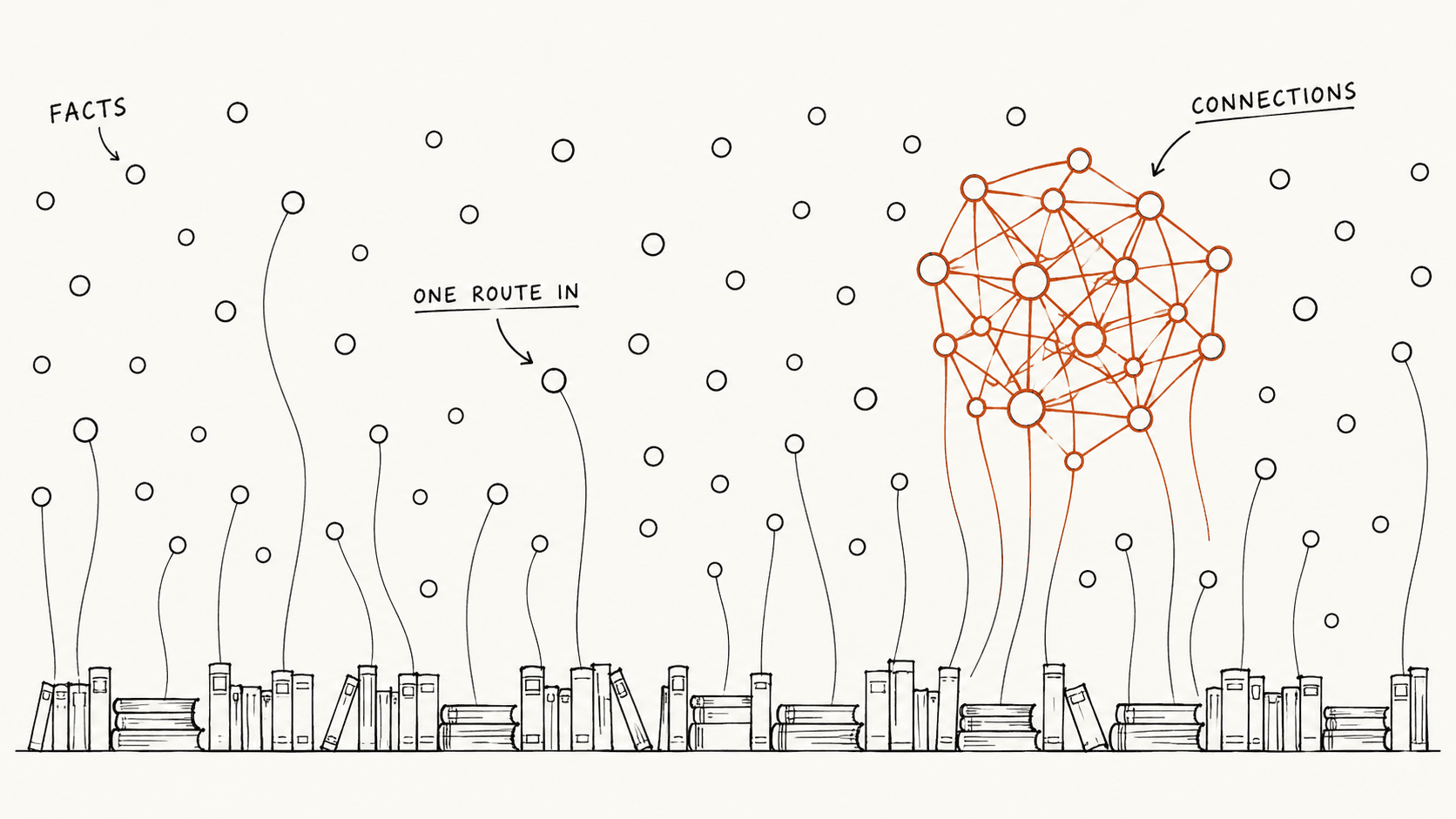
Picture a city. Facts are buildings, connections are roads.
A building with one narrow road reaching it is technically in the city. But you will only ever arrive if you take that exact road. Forget the road and the building may as well not exist. It has not been demolished. You just cannot get there.
That is what an isolated fact is. You learned the capital of a country by repeating it, so there is one route in, through the words of the question you practised. Ask it a different way and nothing comes.
A building with twelve roads is different. You can be heading somewhere else entirely and pass it. Any neighbour leads to it.
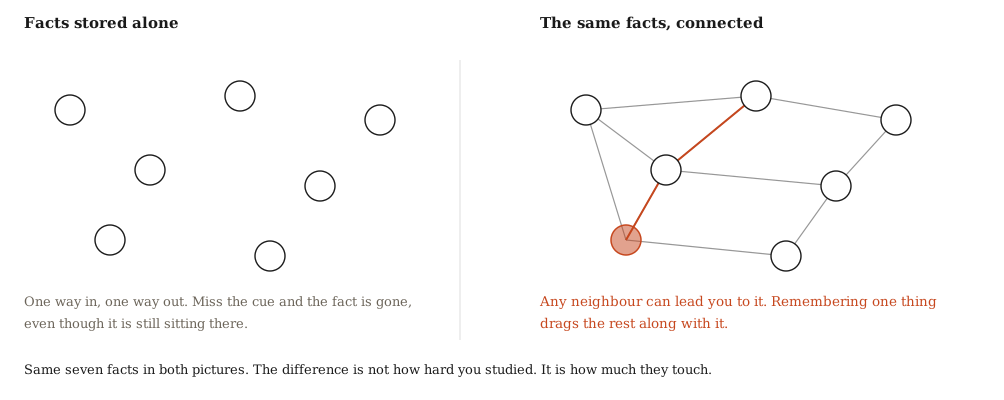
Psychologists call the mechanism spreading activation.6 Bringing one idea to mind partly activates everything attached to it, which is why a smell can return an entire afternoon from childhood. You did not search for the memory. Something adjacent to it lit up.
Forgetting is usually not loss. It is a failure to find a route to something that is still there.
Why rereading feels like learning and is not
In the 1880s Hermann Ebbinghaus spent months testing himself on nonsense syllables and plotting how quickly he lost them.3 His forgetting curve is steep at first and then flattens, and it has held up for well over a century.
Two things reliably change that curve, and neither is the thing most people do.
Spacing. The same total study time produces stronger retention when it is spread out rather than packed together. A 2006 review covering hundreds of experiments found this holds across ages, materials, and intervals.5
Retrieval. Trying to recall something strengthens it more than reading it again. In one well known study, students who read a passage once and then tested themselves remembered substantially more a week later than students who read it four times, even though the rereaders felt more confident.4
Hold on to that last detail, because it explains a lot of wasted evenings. Rereading produces a feeling of knowing. Fluent text is easy to process, and your brain reads that ease as familiarity. The confidence goes up while the memory does not.
Highlighting is the same trap in a different colour. It feels like work. It is mostly recognition.
The strongest move is connecting, not repeating
There is a third thing, and it is the one this whole article turns on.
In 1972 two researchers proposed that how well you remember something depends on how deeply you process it.7 Notice the shape of a word and you keep it briefly. Work out what it means and relate it to something you already know, and it lasts.
This is called elaboration, and in plain terms it means answering one question about every new idea: what does this connect to that I already have?
The question does something specific. It forces the new idea and the old one to activate at the same time, which is the exact condition under which a connection strengthens. You are not being encouraged to be thoughtful for its own sake. You are building the road while both buildings are standing in front of you.
It also explains why creativity feels like luck. A new idea is usually two existing ideas touching for the first time. People who seem to produce them constantly are not generating from nothing. They have a denser network, so more things are within reach of each other.
Why your notes are not helping
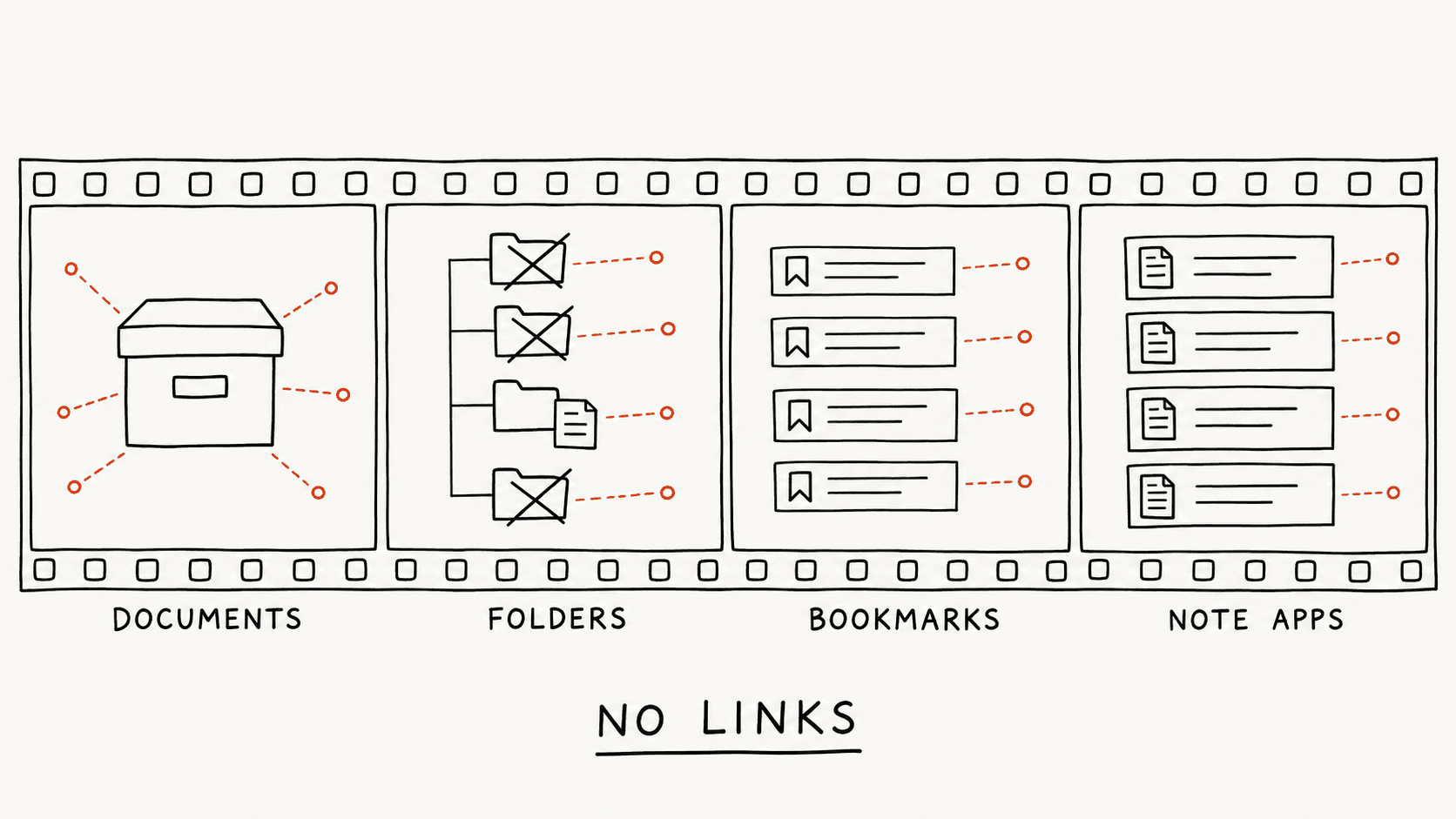
So the goal is connections. Now look honestly at the tools you use, and ask what each one does to help you make them.
Documents
A document is a container with a lid. Whatever you write in a Google Doc or a Word file is sealed inside it.
Write about pricing in one document and about client onboarding in another, and the two never meet, even when the useful insight is exactly the thing that sits between them. To find it you would have to already suspect it was there, open both, and hold them side by side.
Folders
Folders force one home per note, and almost nothing has one home.
A note about automating an invoicing workflow belongs under automation, and finance, and that client, and the tool you used. You must pick one. Every other route to it is now closed, and you closed them at the moment you were least able to predict which one you would want.
That is the deep problem with folders. They are a hierarchy imposed on knowledge that is a network. The structure fights the material.
Bookmarks and screenshots
These are the worst of the group, because they feel the most like progress.
Saving a link involves no processing at all. You did not decide what mattered, restate anything, or connect it to something you knew. You moved a URL.
There is a finding worth knowing here. In 2011 researchers showed that people who expected information to remain available remembered less of the information itself, while remembering more about where to find it.8 Knowing something is saved is enough for your brain to stop holding on to it.
Which means an unread bookmarks folder is not neutral. Saving the article can leave you with less than reading it and saving nothing.
Note apps and clippers
Apple Notes, Evernote, and the rest are better, because at least you wrote something. But they inherit the same assumption: notes are items in a list, sorted by date or notebook, related to each other by nothing.
They are storage. Storage was never the bottleneck. Your notes have no shortage of facts and no connections at all, which is precisely the left-hand side of the diagram above.
What a second brain actually is
A second brain is a set of notes outside your head where the links between ideas are recorded as carefully as the ideas themselves.
That is the whole definition. Not a productivity system, not a folder structure, not a methodology with an acronym. If your notes point at each other, you have one. If they sit in a list, you have a filing cabinet.
The point of putting it outside your head is not storage either. It is that connections in your head are invisible and unreliable. You cannot see them, count them, or check whether the one you made last year still makes sense. Written down, they persist, and they accumulate while you are not thinking about them.
Where the brain comparison stops being true
You will read a lot of writing that says linked notes work because they mirror how neurons connect. It is a satisfying line and it is not accurate, so it is worth being clear about the limits before relying on it.
A neuron does not read anything. Connections between neurons are weighted, one directional, and formed by chemical processes over which you have no conscious say. There is no meaning in a synapse. A link between two notes is a deliberate decision made by a person who understood both.
So the comparison is a metaphor, not a mechanism. The reason linked notes work has nothing to do with resembling brain tissue. It works because writing the link forces the elaboration step, and because the connection is then still there in a year when your own has faded.
That distinction matters practically. Believing your vault is a brain leads to collecting and admiring the graph. Understanding that the value sits in the act of connecting leads to writing fewer notes and thinking harder about each one.
Why Obsidian fits this
Once you know the goal is connections, the requirements for a tool get short. It has to make linking effortless, show you the links in both directions, and still be readable in ten years.
Obsidian does those three things, and the reasons are worth separating because only some of them are about Obsidian at all.
Links you can make while writing
You link by typing two brackets and a note name in the middle of a sentence. If the note does not exist yet, the link still works and the note gets created when you eventually click it.
That last detail sounds minor and is not. It means you can record a connection at the moment you notice it, without stopping to decide where the other note should live. The cost of connecting drops to almost nothing, and you do far more of anything that is cheap.
Backlinks, which is the part that changes things
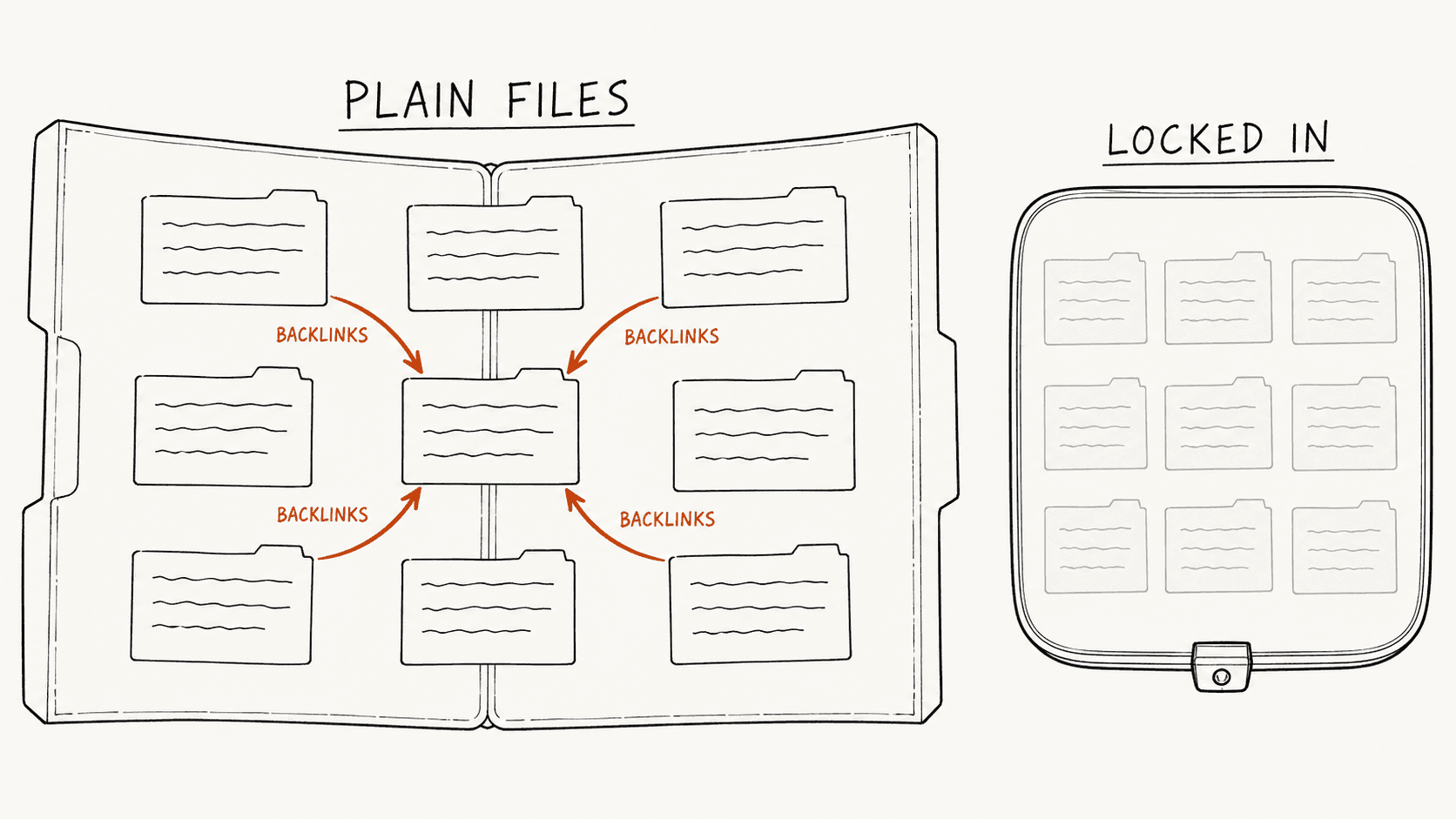
Every note automatically shows you everything that points at it. You link from A to B, and B now knows about A without you doing anything.
This is the feature that has no equivalent in a document or a folder. Open a note you wrote eight months ago and you find the four notes that have since referred to it, most of which you have forgotten writing. Your past thinking arrives without being searched for.
It is worth being honest that Obsidian did not invent this. Bidirectional links go back to the earliest hypertext systems and have appeared in several tools since. Obsidian made them ordinary.
Plain files that outlive the app
Your notes are Markdown text files in a normal folder on your own disk.9 No database, no proprietary container, no account required to open them.
This is the property that matters most over a long horizon, and it is the one people weigh least when choosing. A second brain is only worth building if it will still be readable when you need it, and the useful test is simple: if this company disappears tomorrow, what happens to my notes?
With plain text the answer is nothing. They are files. Every tool that has ever existed can read them, including tools that do not exist yet. That patience is now paying in a way nobody planned for, because a folder of Markdown happens to be exactly what a language model can read. I wrote about that side of it in I stopped losing ideas after I combined Claude with Obsidian.
What this looks like in practice
Abstract advice about connection is easy to agree with and hard to act on, so here is a concrete sequence.
You read something about artificial intelligence and make a note. Not a copy of the article. A few lines in your own words about what it actually claimed.
While writing it you mention machine learning, so you link it. A week later you note something about prompt engineering, and it links back to the same AI note. A month after that you automate part of your own billing and it turns out to lean on the same ideas, so that links too.
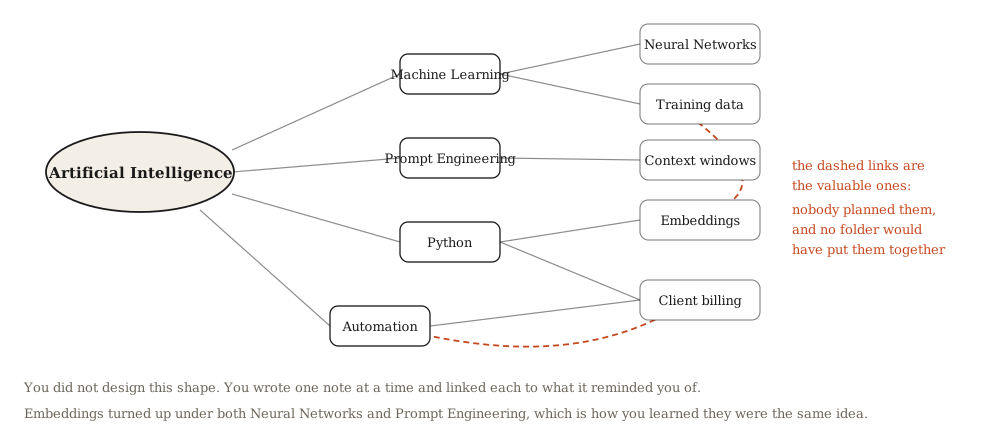
Look at the dashed lines. Embeddings turned up while you were reading about neural networks and again while you were working on prompts, and connecting them is how you learned they were the same idea wearing two labels.
Nobody designed that. There is no folder structure that would have produced it, because at the time you filed the first note you had no idea the second one was coming.
That is the whole method: write in your own words, link to what it reminds you of, and let the shape emerge. The structure is a result rather than a plan.
Starting without drowning
The common failure is importing everything you have ever saved on day one. You end up with a large vault of unread material and no links, which is your bookmarks folder again with a nicer interface.
- Start empty. Do not import anything.
- Write notes only about things you are actually working on or reading now.
- Every time you write a note, add at least one link to an existing note. If you cannot find one, that is a signal the note is too isolated to be useful yet.
- Write in your own words, always. Copied text creates no connection, because you never processed it.
- Keep notes short and about one idea. A long note about six things cannot be linked to precisely.
The third rule does most of the work. Requiring a link forces the elaboration question every time, and that question is the mechanism, not the software.
What actually improves
Being specific here matters, because this genre tends to promise a transformed mind and deliver a tidy folder.
Recall improves for anything you connected. Not for everything you saved. Notes you wrote and linked have several routes to them; notes you pasted have none, and they will be as lost as the bookmark would have been.
Learning a new field gets easier as your network in it grows, which is uneven rather than steady. The first month in an unfamiliar subject is slow, because almost nothing connects to anything. Later material in the same field arrives with somewhere to attach, and that is when it starts to feel quick.
Writing gets easier because the raw material already exists. Most of the difficulty in a first draft is deciding what you think. If you have been recording what you think as you go, drafting turns into assembling and arguing rather than starting from nothing.
You notice yourself changing your mind. Backlinks put an old position next to a new one, which ordinarily never happens, because you only ever read one note at a time and each sounds reasonable alone.
Decisions get better mainly by getting less repetitive. You stop rediscovering the same conclusion, and you can see what you thought last time and why.
When this is the wrong advice
Three cases, and the first is the most common by a distance.
When the system becomes the hobby. Building the vault is pleasant, visible, and infinitely adjustable, and it produces the same feeling of progress that highlighting does. If you are tuning plugins and admiring the graph more often than you are writing notes about real work, this has become procrastination with good branding. The graph is a by-product and looking at it achieves nothing.
When you need to memorise specific facts on a deadline. A medical exam, a language, a certification. Connection helps understanding, but for reliable recall of a defined set of items by a fixed date, spaced repetition with active testing is the tool with the evidence behind it.54 Use flashcards for that and do not feel you have failed at anything.
When you are not going back to it. All of this assumes a long horizon. If you need something for one project this month and never again, a document is fine. The value of a second brain comes from accumulation, and accumulation needs years.
The takeaway
You have not been forgetting because your memory is poor. You have been storing facts in a system built for storing facts, when the thing that makes knowledge stick is what surrounds it.
So change the question you ask when you learn something. Not how do I save this. What does this connect to that I already have?
Write the answer down. Link it. Do that for a year and you will have something your memory cannot give you: a record of your own thinking that gets denser instead of dimmer.
Your brain was never designed to remember everything. It was designed to make connections. The better your notes connect, the better you think.
Sources
- Donald Hebb, The Organization of Behavior, 1949. The phrase “neurons that fire together wire together” is a later summary, coined by Löwel and Singer in 1992, rather than Hebb’s own wording.
- Bliss and Lømo, Long-lasting potentiation of synaptic transmission in the dentate area of the anaesthetized rabbit, Journal of Physiology, 1973. The first direct demonstration of long-term potentiation.
- Hermann Ebbinghaus, Über das Gedächtnis, 1885. The original forgetting curve, produced by testing himself on nonsense syllables.
- Roediger and Karpicke, Test-Enhanced Learning, Psychological Science 17(3), 2006. Retrieval practice beat repeated study at one week, while students judged repeated study to be more effective.
- Cepeda, Pashler, Vul, Wixted and Rohrer, Distributed Practice in Verbal Recall Tasks, Psychological Bulletin 132(3), 2006. A review of 254 studies covering more than 14,000 participants.
- Collins and Loftus, A Spreading-Activation Theory of Semantic Processing, Psychological Review 82(6), 1975.
- Craik and Lockhart, Levels of Processing: A Framework for Memory Research, Journal of Verbal Learning and Verbal Behavior 11(6), 1972.
- Sparrow, Liu and Wegner, Google Effects on Memory, Science 333(6043), 2011. Participants who expected information to remain accessible recalled less of it, and more about where it was stored.
- Obsidian documentation, How Obsidian stores data: “Obsidian stores your notes as Markdown-formatted plain text files in a vault. A vault is a folder on your local file system, including any subfolders.”