
Workflow
I Stopped Losing Ideas After I Combined Claude With Obsidian.
By Muhammad UmarAugust 20, 20256 min readIssue #7
Capture was solved a decade ago. Getting anything back out never was, and that is the half nobody built.
The idea always arrives at the wrong moment. On a walk, mid-conversation, halfway through something else. So you write it down, because writing it down is what you are supposed to do, and the writing down works. That part has never been the problem.
The problem arrives months later, when you solve something and get the quiet, unpleasant feeling that you have solved it before. Somewhere in your notes is the version of you who already worked this out, took the trouble to record it, and cannot reach you.
That is not a discipline failure. It is a design failure, and it is worth being precise about where it sits, because the usual advice aims at entirely the wrong half.
The problem: capture is solved, recall is not
Look at what the last decade of tools actually built. Quick capture. Mobile capture. Web clippers. Voice notes. Email to inbox. Every one of them makes it easier to put something in.
Now count the tools that made it easier to get something out. Search, tags, folders, backlinks. Those are the same four we had in 2010, and each of them fails in the same specific way.
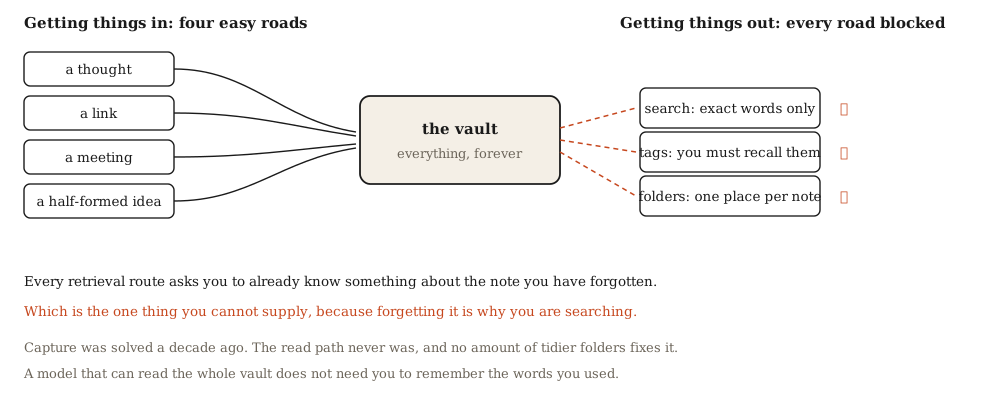
Search wants the words you used. Not the idea, the words. You wrote "batching writes to cut round trips" and eight months later you search for "database performance", which appears nowhere in the note, so the note does not exist.
Tags want a decision you made in the past. You have to have tagged it, tagged it consistently, and remembered which vocabulary you were using that month. Most vaults contain two or three competing tag systems laid down in different years by the same person.
Folders want one true home per note. Almost nothing has one. The note about pricing an automation project is pricing, and sales, and automation, and a specific client, and it can live in exactly one place.
Every route out asks you to already know something about the note you have forgotten. That is the one thing you cannot supply.
Which explains why reorganising never helps for long. Restructuring the folders, rebuilding the tags, adopting whichever methodology is current: all of it is work on the write path. The read path is untouched, and the read path was the broken one.
The fix: put a reader on top of the vault
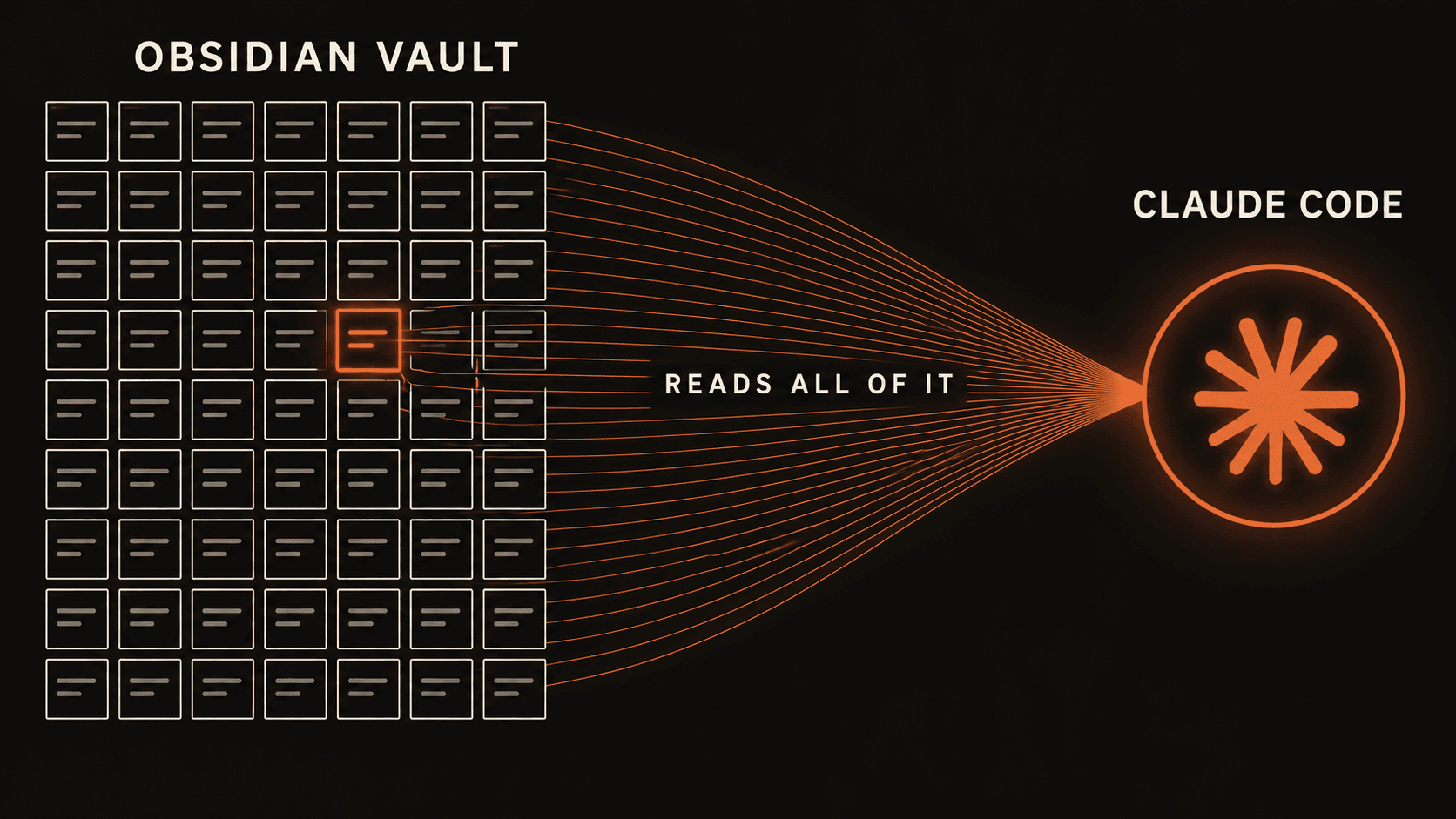
What changed for me was not a better system for filing things. It was pointing Claude Code at the vault folder and letting it read.
The setup is unremarkable, which is the point. An Obsidian vault is a folder on your file system holding Markdown-formatted plain text, and nothing else.1 Claude Code works on folders of files. There is no integration to build, no plugin, no sync service, no API key holding your notes hostage. You open the vault directory and start asking.
cd ~/notes
claude
That is the whole installation. Everything below is what becomes possible once you have done it, and the reason each one was impossible before.
Asking by meaning instead of by word
The question that used to fail is the one you can now ask directly: have I thought about this before? You do not need the note, the words, the tag, or the date. A reader that has seen everything can recognise the idea in whatever words you happened to use at the time.
This is the single change that matters, and every other benefit is downstream of it. The failure I described at the start, rediscovering something you already knew, is precisely a failure to match an idea against its old wording. That is the task a language model is actually good at.
Questions that span notes
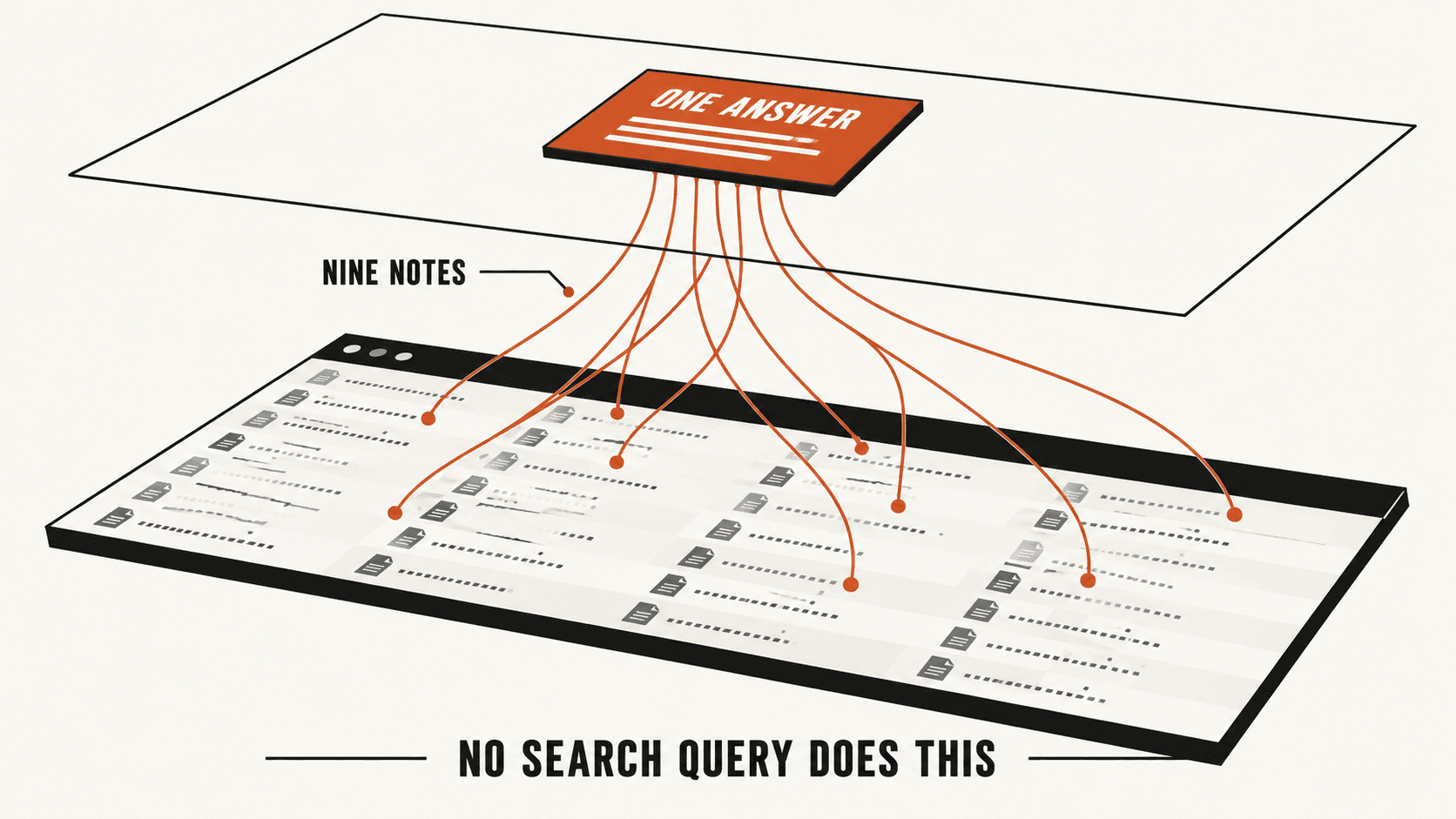
Search returns documents. It cannot answer a question whose answer is distributed across nine of them, and a surprising amount of what a vault knows is distributed.
- What have I repeatedly said I would do and never started?
- Where do my notes from this year contradict what I wrote last year?
- Which of these open questions have I actually since answered somewhere else?
- What keeps coming up that I have never given its own note?
Every one of those requires reading across the vault and holding it all at once. None of them is expressible as a search query, which is why nobody was asking them. The questions were always available. The thing that could answer them was not.
The contradiction check
This is the one I did not anticipate and now use most. Ask what in the vault disagrees with itself.
A note-taking system is a record of what you believed at various times, and beliefs move. Ordinarily you never see the movement, because you only ever read one note at a time and it always sounds reasonable in isolation. Held side by side, the old position and the new one are visibly different, and the interesting question is which one you actually changed your mind about and which one you simply forgot.
Writing back into the vault
Because the vault is plain files and Claude can write as well as read, retrieval and capture stop being separate activities. The answer to a question can become a note, correctly linked, without a copy and paste step that you will skip when busy.
That closes a loop that was open in every system I have used. Previously, thinking done while searching evaporated, because recording it was a second task. Now the summary that took real effort to produce lands in the vault as its own note, and next time it is the thing that gets found.
Why Obsidian in particular
The format is the reason, not the interface. Obsidian stores plain Markdown in an ordinary folder, so the notes are readable by anything, including tools that did not exist when you wrote them.1 That property is what makes this work at all.
A vault locked inside a proprietary database can only be read by whatever its vendor decides to build. A folder of text files is legible to every tool that will ever exist, which means the value of writing things down keeps rising as the tools improve. Plain text was the boring choice for years, and the arrival of models that can read is exactly when that patience pays.
The backlinks and the graph view are pleasant. They are not why this works. Any folder of Markdown gets the same benefit.
When this is the wrong advice
Three cases, and the first is the one most likely to apply to you.
Your notes are not worth reading yet. This makes a vault legible. It does not make it valuable. If what you have is a few hundred clipped articles you never processed, a reader will faithfully report that you have collected a lot and concluded nothing. Fixing the read path only pays once there is something on the other side of it worth reaching.
Your notes contain things you cannot send anywhere. Client material under contract, personal medical detail, anything covered by an agreement you signed. A vault is usually a mix, and the sensitive files are rarely marked as such. If separating them is not practical, this is a straightforward no rather than a thing to be careful about.
You are hoping it will do the thinking. It reads what is there. Ask it to find the pattern in your notes and it will find one, whether or not there is one, and a confident synthesis of shallow material reads exactly like a confident synthesis of deep material. The quality of what comes out remains bounded by the quality of what you put in, and this makes that boundary much easier to mistake.
The takeaway
Stop trying to file things better. The filing was never the problem, and every hour spent restructuring folders is an hour spent improving the half that already worked.
Keep your notes in plain text, in a folder, in whatever mess they naturally accumulate. Then put something on top that can read all of it at once. The ideas were never lost. They were just written in words you no longer remember using.
Sources
- Obsidian documentation, How Obsidian stores data: “Obsidian stores your notes as Markdown-formatted plain text files in a vault. A vault is a folder on your local file system, including any subfolders.” Obsidian entered public beta in March 2020 and reached version 1.0 in October 2022.