
Business
One customer is enough to start.
By Muhammad UmarMay 4, 20256 min readIssue #3
You do not need a market. You need one person with a problem and a budget.
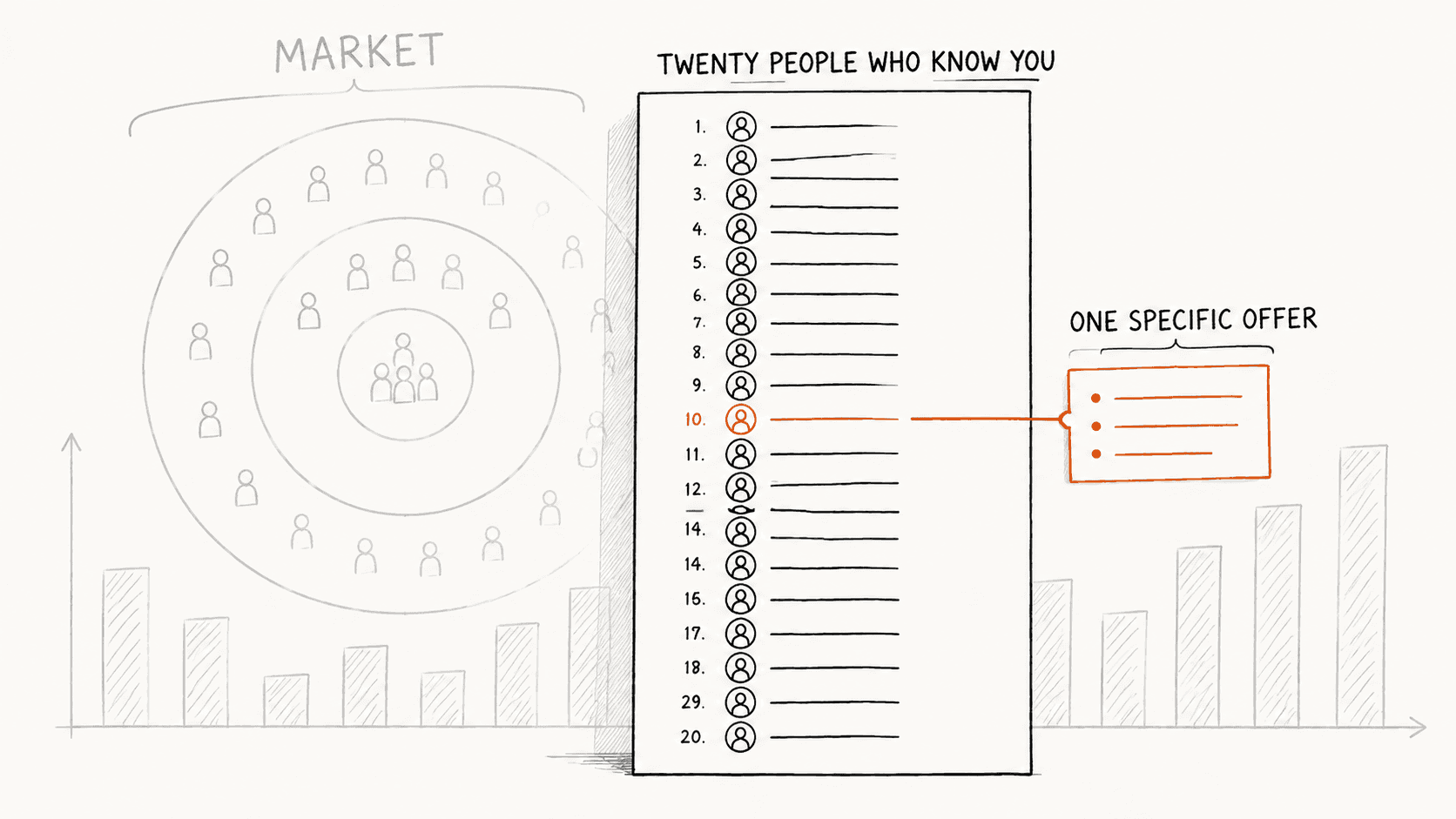
Most people wait for a market. They want the research, the competitor grid, the total addressable number that makes the whole thing feel reasonable before they begin.
I understand the instinct. It also kept me from starting for about two years.
What actually got me moving was smaller: one company, one broken workflow, one person willing to pay to make it stop hurting.
Why one is the right number
A market is an abstraction. You cannot ask a market what annoys it. One customer answers the phone.
- One customer gives you the exact words the problem is described in.
- One customer tells you what they already tried, and why it failed.
- One customer proves someone will pay, which is the only proof that counts.
- One customer is small enough that you can actually deliver something excellent.
Do that well and you have not built a business yet. But you have built the only thing a business grows out of: a real problem you have solved before.
How to find the first one
Not with a launch. With a list.
Write down twenty people who already know you can do the work: old colleagues, past clients, people whose questions you answer for free. That list is worth more than any audience you do not have yet.
Then send a short, specific message. Not "let me know if you ever need anything." Something closer to: "You mentioned your team still exports that report by hand every Monday. I build things like that. Want me to take a look?"
Vague offers get polite replies. Specific offers get budgets.
What to do once you have them
Deliver more clearly than they expect. Not more features. More clarity. Tell them what you are doing, what it will not do, and when it will be in their hands.
Charge them, and charge properly
The instinct with a first customer is to go cheap, or free, to lower the risk of hearing no. It does lower that risk. It also destroys the only information you were there to collect.
A free yes tells you the problem is worth zero effort to avoid. A paid yes tells you it is worth money, which is the only signal that survives contact with a second customer. Price is not a reward for the work. It is the measurement instrument, and discounting it to nothing is like taking the thermometer out of the oven because the reading made you nervous.
There is a practical version of this too. Someone who pays turns up to the calls, sends the data, and tells you when it is wrong. Someone who does not pay is doing you a favour, and people doing you a favour are polite. Politeness is the enemy here. You need the person who is annoyed enough to tell you the export is still broken.
Build the part that generalises
Serve the customer completely. Shape the product around the part of their problem that other people also have. Those are different instructions, and holding both is the whole difficulty of the first engagement.
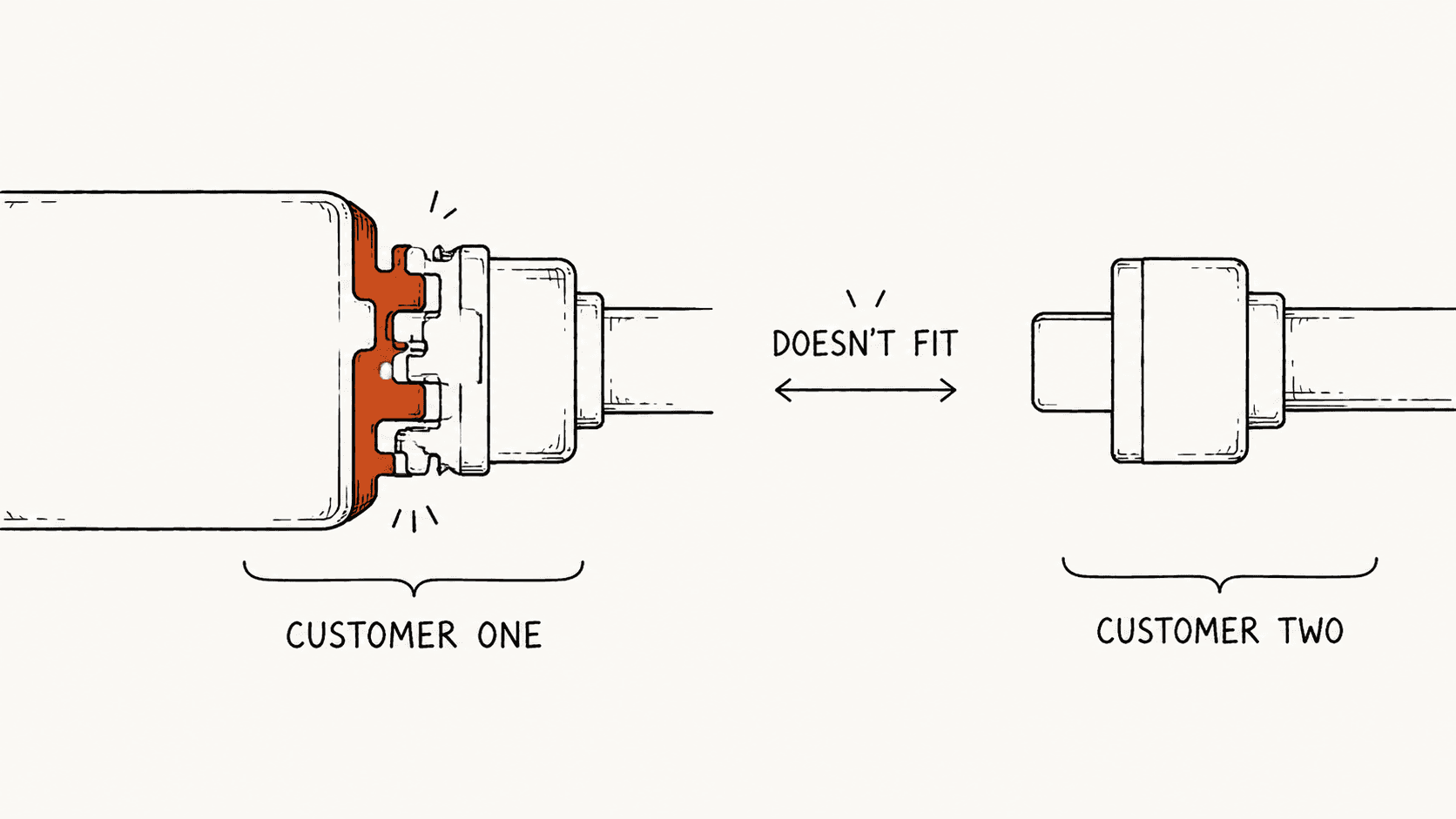
In practice that means separating the work into two piles as you go. One pile is the thing itself, the logic of the problem, which is likely to recur. The other is the wiring into their world: their export format, their naming, their one strange approval step. Do both, properly. Just know which is which, because the second pile is the part you will throw away for customer two, and knowing that in advance stops you from building on top of it.
You will get the split wrong. Everyone does. But an engagement where you were trying to notice the boundary leaves you with something reusable, and one where you were not leaves you with a very well-built dead end.
Then write down what you learned in plain language: the problem, the approach, the result. That note becomes your case study, your next offer, and half your content for a month.
When one customer is a trap
One customer proves someone will pay. It does not prove anyone else will, and the gap between those two is where a lot of people quietly build themselves a job instead of a business.
There is a test that separates them, and it is a single question: could you describe the problem without naming the company? If the answer is yes, you have found a problem that exists elsewhere. If you can only describe it as “the thing their finance team does with that spreadsheet because of how their ERP was configured in 2019”, you have found a customer, not a market.
- The problem is genuinely theirs alone, so you are building bespoke work, which is fine, but call it what it is.
- They are a friend doing you a favour. A yes out of kindness is not a signal, and it is the most expensive kind to misread.
- They can pay, but not enough to fund the learning, so you end up subsidising your own research.
- You bend the product around them so far that customer two would need it bent back.
The last one is the common failure. It happens gradually, through reasonable-sounding requests, and you only notice when the second sale needs a rewrite. Serve them completely; shape the product around the part of their problem that other people also have.
Where the second one comes from
The claim that the second customer is usually someone who watched you solve the first is worth unpacking, because it is not luck and it does not happen on its own.
The people who watched are a specific, small group: your customer’s counterparts at other companies, the vendor whose tool you integrated with, the contractor who was in the same meetings, and anyone your customer complained to while the problem was still unsolved. That last group is larger than you think. People discuss their expensive annoyances, and the solution is a natural end to a story they were already telling.
What turns that from a possibility into a pipeline is being describable. If your customer can explain what you did in one sentence, they will do your selling accidentally, in conversations you are not present for. If explaining it requires context about their systems, the story stops at “we got someone in, it went well”, which generates goodwill and no work.
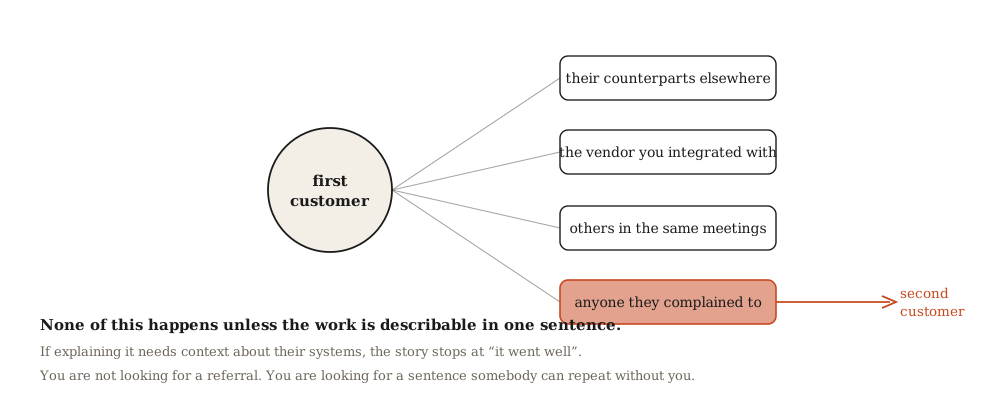
You are not looking for a referral. You are looking for a sentence somebody can repeat without you.
Which gives you something concrete to do at the end of the engagement. Write the one-sentence version yourself: the problem, in the customer’s own words, and what changed. Then give it to them. Not a case study for your website. A sentence for their mouth. Most people are glad to have it, because summarising your work was a small task they had not got around to.
The honest limit: this is a slow mechanism, and it fails entirely if the first engagement went badly. There is no volume knob on it. What it does give you is a second customer who arrives already believing you can do the work, which is a different and much shorter conversation than the first one was.
The takeaway
Stop looking for a market and go find one person. Solve their problem properly. The second customer is almost always someone who watched you solve the first.